Solar for your society's common meter.
Lifts, pumps and common lights are paid from the maintenance fund. A plant on the terrace cuts that bill, with ₹18,000 per kW of subsidy.
OUR PROMISES
Why societies choose us
- 01 ₹18,000 per kW, filed for you We file the PM Surya Ghar application in the society's name for common facilities, up to 500 kW.
- 02 A written proposal for the committee Sized from twelve months of common meter bills, with cost, subsidy and payback laid out for the managing committee or the AGM.
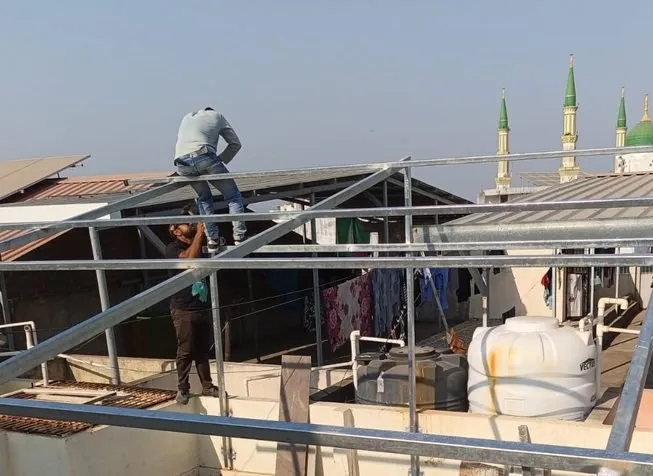
- 03 Built around tanks and lift rooms Raised structures clear the water tanks and keep the terrace usable for members.
- 04 Row houses in the same visit In a row house or bungalow society, each owner can also claim up to ₹78,000 on their own roof. We can file them in one batch.
Two routes, depending on the kind of society
The first question is who owns the roof and whose meter the solar will feed. A mixed society can use both routes at once.
| Society type | Who applies | Subsidy | Meter it feeds |
|---|---|---|---|
| Apartment building or towers | The society or RWA | ₹18,000 per kW, up to 500 kW | Common meter |
| Row houses, each with its own roof | Each house owner | Up to ₹78,000 per house | That house's meter |
| Bungalow society | Each owner, and the society for its common meter | Both, separately | House meters and the common meter |
Sizing and price
Divide the monthly units on the common meter bill by about 128, which is what one kWp makes in a month around Bharuch. Use twelve months of bills, because pump and lift use rises in summer. Size to the common load and no more, since exported units are credited at only about ₹2.25 each.
| Society | Common units a month | Array | Cost | Subsidy | Society pays |
|---|---|---|---|---|---|
| One block, pumps and lights | 400 | 3.3 kWp | ₹1,65,000 | ₹59,400 | ₹1,05,600 |
| Two lifts, pumps, lights | 1,500 | 12.1 kWp | ₹6,05,000 | ₹2,17,800 | ₹3,87,200 |
| Several towers with lifts | 4,000 | 31.35 kWp | ₹15,67,500 | ₹5,64,300 | ₹10,03,200 |
Documents a society usually needs
- Society registration certificate
- Committee or general body resolution approving the plant
- Latest common meter bill with the DGVCL consumer number
- Society PAN and a bank account in the society's name
- NOC from any flat owners with terrace rights
- Roof photos and a rough sketch of the terrace
Who looks after the plant
The society owns the plant. The resolution should say who arranges cleaning, who keeps the warranty papers and who reads the monthly generation figures. The cleaning cost and a small repair reserve should come from the maintenance fund, so the plant does not lose output when the committee changes.
Questions people ask
How much subsidy does a housing society get?
A registered group housing society or RWA can get ₹18,000 per kW under PM Surya Ghar for solar on common facilities, up to 500 kW. That covers lifts, water pumps, common lights and EV charging on the common meter. The application goes in the society's name.
Can one flat owner put panels on the terrace?
Usually not. The terrace in an apartment building belongs to the society, and there is rarely space for every flat. The practical route is a common-area plant, which lowers the maintenance charge every flat pays.
Will the society's bill go to zero?
No. Fixed charges on the common meter stay. A plant sized to the common load cuts the energy part of the bill, which for a mid-size society with two lifts is about ₹10,000 to ₹12,000 a month.
Can we still use the terrace?
Yes. We raise the structure to clear the water tanks and keep walkways open, and we plan the layout around the lift room and the access door.
REAL INSTALLS
GUIDES